

Ewald Kubota has been serving the farm equipment markets in Austin and San Antonio since the 1940s. In 2024, the company acquired family-owned dealership and long-tome friends of Ewald Kubota, Lansdowne-Moody, adding nine new locations to its existing eleven. Both dealerships were already DIS users, which put them in a strong position to merge their operations and get the most out of their DMS.
But like any merger, there were a few wrinkles to iron out. That’s where having timely, detailed reporting proved essential.
We spoke with Stefan Schriewer, Chief Operations Officer at Ewald Kubota, about how DIS Analytics has supported the transition.
The Power of an Integrated Analytics Platform
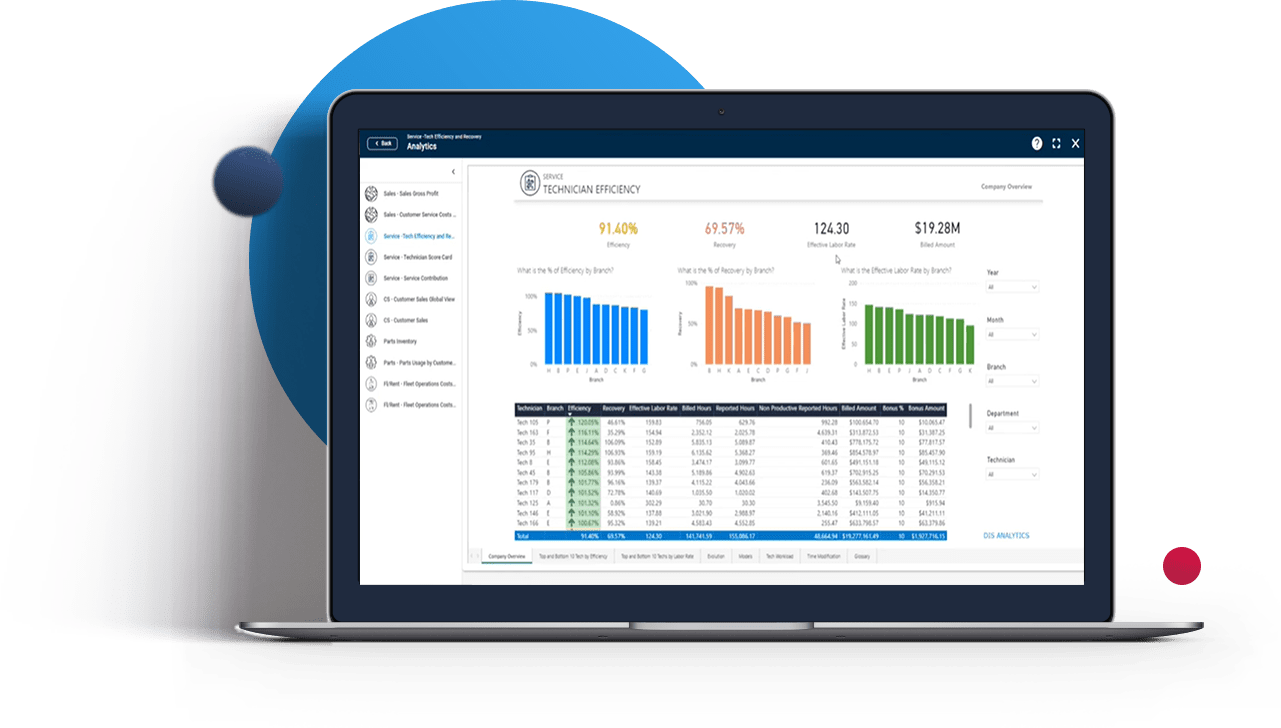
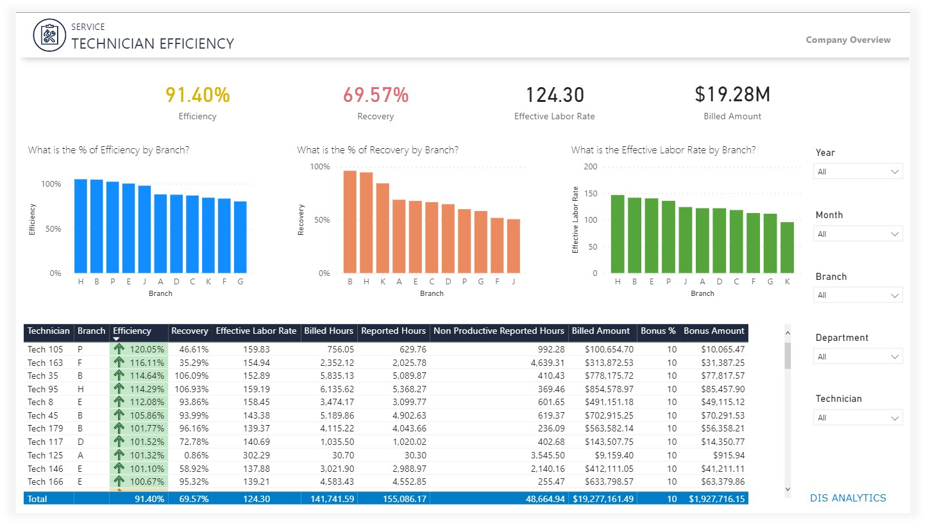
DIS Analytics is our integrated dealership analytics platform that offers a library of dynamic dashboards to easily track key success metrics, access and understand up-to-date data, and compare performance between branches and over time.
Stefan Schriewer: “It’s a big time-saver for me. I don’t have to go in and put the reports together and then sanity-check the numbers afterwards to make sure they’re correct.
Sometimes putting that data into a form that’s readable or understandable—like making charts or graphs that bring the data to life—can be time-consuming, especially with as many locations as we have.
Now, I can pull up a report, see everything consolidated, and if I need to go a little deeper, I can drill down into specific areas or filter by location, time frame, or whatever I need. It makes everything much easier and way faster.”
Stefan’s Favorite DIS Analytics Features
- Consolidated Reporting: Accurate reporting for all locations and data in one place, with easy-to-understand dashboards.
- Cross-Location Consistency: Ensures all managers are looking at the same KPIs and data, reducing discrepancies.
- Weekly/Monthly Tracking: Automated reports update key metrics like recovery, efficiency, and productivity regularly without manual effort.
- Dynamic Drilldowns: Filter by location, time frame, specific area, all the way down to individual technicians.
Easing the Transition During the Acquisition
Because Lansdowne-Moody was already running on DIS, bringing the businesses together was a fairly smooth transition. But every dealership operates a little differently.
Stefan Schriewer: “Other dealerships—and this isn’t wrong, it’s just a different way of looking at it—would say, ‘OK, we’re just looking at the amount of time you’re on the clock versus the amount of time you’ve billed.’ To me, that’s a reflection of efficiency.
When I’d go to a service manager and say, ‘We have a problem with recovery,’ in their mind they’re thinking, ‘What is that? I look at it as efficiency.’ It can get confusing and frustrating for everyone.
Now I can say, ‘Here’s what we’re defining as recovery. You can click on the tab if you want to see how the math is done. This is efficiency, and here’s your effective.’ We can have a conversation about recovery and what we can do to fix it, and then go deeper to find out exactly what’s causing either the issue or the success.”
Streamlining Communication Across Dealership Locations
One of the biggest challenges when running a multi-location dealership is keeping teams on the same page.
Stefan Schriewer: “One thing that’s good is it’s not just me producing a spreadsheet or another manager producing a spreadsheet and then we distribute that. Sometimes the numbers end up different based on where the data was pulled from.
This helps us make sure we’re all speaking the same language. We’re all looking at the same data, the same graphs, and using the same KPIs. It’s really helped us streamline communication and open everything up to everyone.”
Supporting the Team’s Success
Greater transparency leads to stronger motivation.
Stefan Schriewer: “The data flows all the way down to the individual technician. We can say, ‘Hey, this is your pay. This is your commission. You get a percentage of all your billed dollars. What can we do? How can we help you maximize your time? Where are we falling short? Do we need more parts? More help? More tools? Do we need to help the layout of the service department? Do you need a service truck?’
All of those conversations can be had, and again, we’re all speaking the same language and talking about the same thing.”
Powerful Insights Without the Added Headcount
Data-driven dealerships often employ teams just to manage their data. But DIS Analytics does it for you.
Stefan Schriewer: “I’ve gone and visited some big dealerships—big RV outfits, billion-dollar-a-year sales places—and they put a lot of emphasis on Power BI. They have staffs of people whose job all day long is data verification and report building.
It’s really nice that, at least for now and with what we’re doing, we don’t have to have that. We’ve already got it. It maintains itself and automatically updates. It’s not only that we’re gaining efficiency by not having to run a report one time; now we’re doing it weekly or monthly if it’s something we’re measuring to manage. The fact that the report updates automatically is a huge time saver.”
A True Partnership
Stefan Schriewer: “I’ve been nothing but happy with what they’ve done, and it’s been happening at a pace that’s really nice.
I fully understand that making a change or building something customer-specific inside the business system is a big deal. It’s not as simple as flipping a switch or changing some basic code.
The team has been really responsive. Anytime I’ve had questions, they’ve been great at explaining things in layman’s terms. A lot of the things about how the data is warehoused and categorized—that’s a heavy lift for sure. They’ve been really good at helping me understand what’s possible and what they can do.”