

Everyone has an opinion on AI.
Some dealers see it as the key to solving every problem in their business. Others see it as an overhyped technology that has no place in an equipment dealership. And if you look at the headlines, you could make a case for either side.
The reality, as it usually does, falls somewhere in the middle.
AI is a technology. It has different implementation options. We got used to saying we use AI when we ask ChatGPT or Gemini a question. Other applications include AI agents that are experts in one of the dealership domains, like accounting or parts service, as well as AI capabilities that can give recommendations “just in process,” such as which parts to include in my order today or creating a quote. As these new applications emerge, this balance is expected to change.
In a 2025 DIS survey of farm and heavy equipment dealers across North America, 49% of dealers said they hadn’t adopted AI at all, while 28% were using it and 23% planned to. If anything, the pace has only accelerated since, but the core challenge remains the same: knowing where AI actually helps and where it doesn’t.
So, let’s cut through the noise. Here’s a practical look at what AI can actually do for your dealership right now, and where you’re better off relying on the people and processes you already have.
Where AI Is Already Making a Difference
AI isn’t a magic wand, but it is genuinely useful in specific areas of dealership operations. The keyword is “specific.” The dealers getting real value from AI aren’t using it for everything. They’re applying it in focused ways where it does the best.
Cutting Down on Repetitive, Manual Work
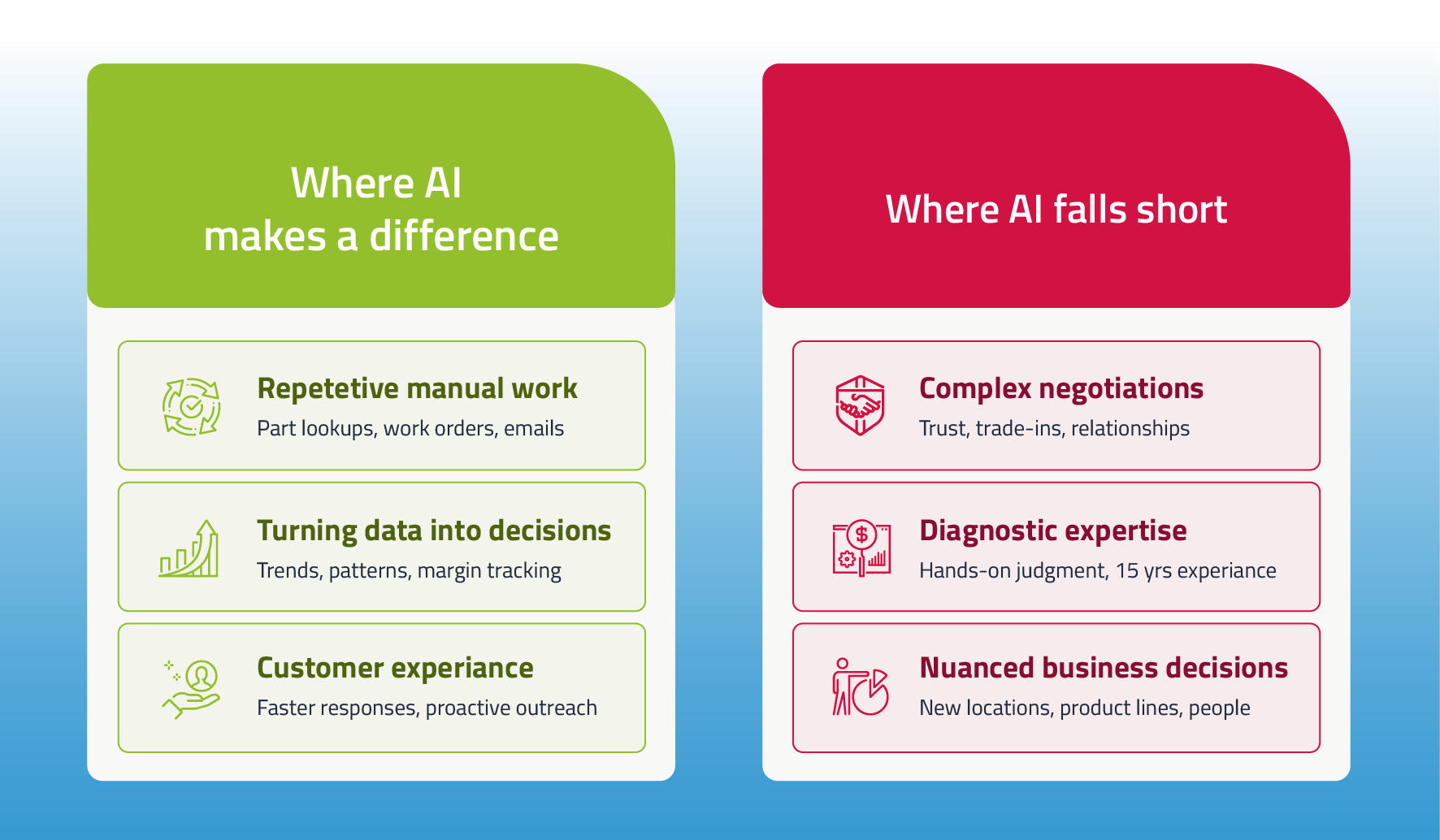
Think about how much time your team spends on necessary but not particularly high-value tasks. Looking up a part number. Pulling a customer’s service history before a call. Creating a work order from scratch. Drafting a follow-up email after a quote.
These are the areas where AI shines. It can surface information in seconds that would otherwise take minutes of searching. It can draft routine communications, auto-populate fields based on historical data, and flag items that need attention before someone has to go looking for them.
That doesn’t mean AI is doing the work for your people. It means your people can spend their time on what actually moves the needle, rather than on busywork that slows them down.
Turning Data into Decisions
Most dealerships are sitting on a goldmine of data and barely scratching the surface. You know this. Your DMS is capturing transaction history, service patterns, parts velocity, customer buying behaviour, and more.
AI can help make sense of all that information by spotting trends and patterns that a person would be unable to catch manually.
- Which equipment unit is likely to come up on service visits?
- What parts are moving faster than usual and might need reordering sooner?
- Where is your gross margin trending compared to the same period last year?
These aren’t hypothetical questions. They’re the kind of insights that AI can deliver today, as long as it’s connected to the right data, which is why the quality and integration of your DMS matters more than ever.
Improving Customer Experience
Your customers’ expectations are changing. They’re used to quick, personalized experiences in other parts of their lives, and they’re starting to expect the same from their equipment dealer. AI can help bridge that gap by enabling faster response times, more relevant recommendations, and proactive outreach based on a customer’s actual equipment and history.
Where AI Falls Short
Here’s where it gets important. Because for every area where AI adds value, there are areas where it’s simply not a replacement for human judgment, expertise, and relationships.
Complex Negotiations and Relationship Building
Buying a piece of heavy equipment is not like buying something online. It involves trust. It involves a customer who wants to look someone in the eye and know they’re getting a fair deal. It involves trade-in evaluations, financing conversations, and sometimes a handshake that’s been 20 years in the making.
AI can’t do that. And it shouldn’t try.
What AI can do is ensure your salesperson walks into that conversation armed with the right information: the customer’s purchase and service history, past preferences, and the current market value of their trade-in. The relationship is still human. The preparation is where AI helps.
Diagnostic Expertise and Technical Judgment
A seasoned technician who has been working on a specific brand of equipment for 15 years carries knowledge that no AI model can replicate. They can hear something in an engine, feel something in a hydraulic system, and know exactly what’s wrong based on experience that’s built over thousands of hours in the shop.
AI can assist with diagnostics by pulling up service history, identifying common failure patterns, and suggesting likely causes based on data. But the final call and the repair itself still belong to the technician.
Navigating Nuanced Business Decisions
Should you take on a new product line? Is it time to open a second location? How do you handle a key employee who’s thinking about leaving? These are decisions that involve context, intuition, industry knowledge, and sometimes a gut feeling that comes from years of running a business.
AI can provide supporting data. It can show you financial trends, market comparisons, and operational benchmarks. But the decision? That’s yours.
What This Means for Your Dealership
The dealers who will get the most out of AI are the ones who stop thinking about it as either a silver bullet or a threat and start thinking about it as a tool, one that’s most effective when it’s built into the systems you’re already using.
But not all AI tools are created equal, and it’s worth understanding the differences—because the approach you choose will determine how much value you actually get.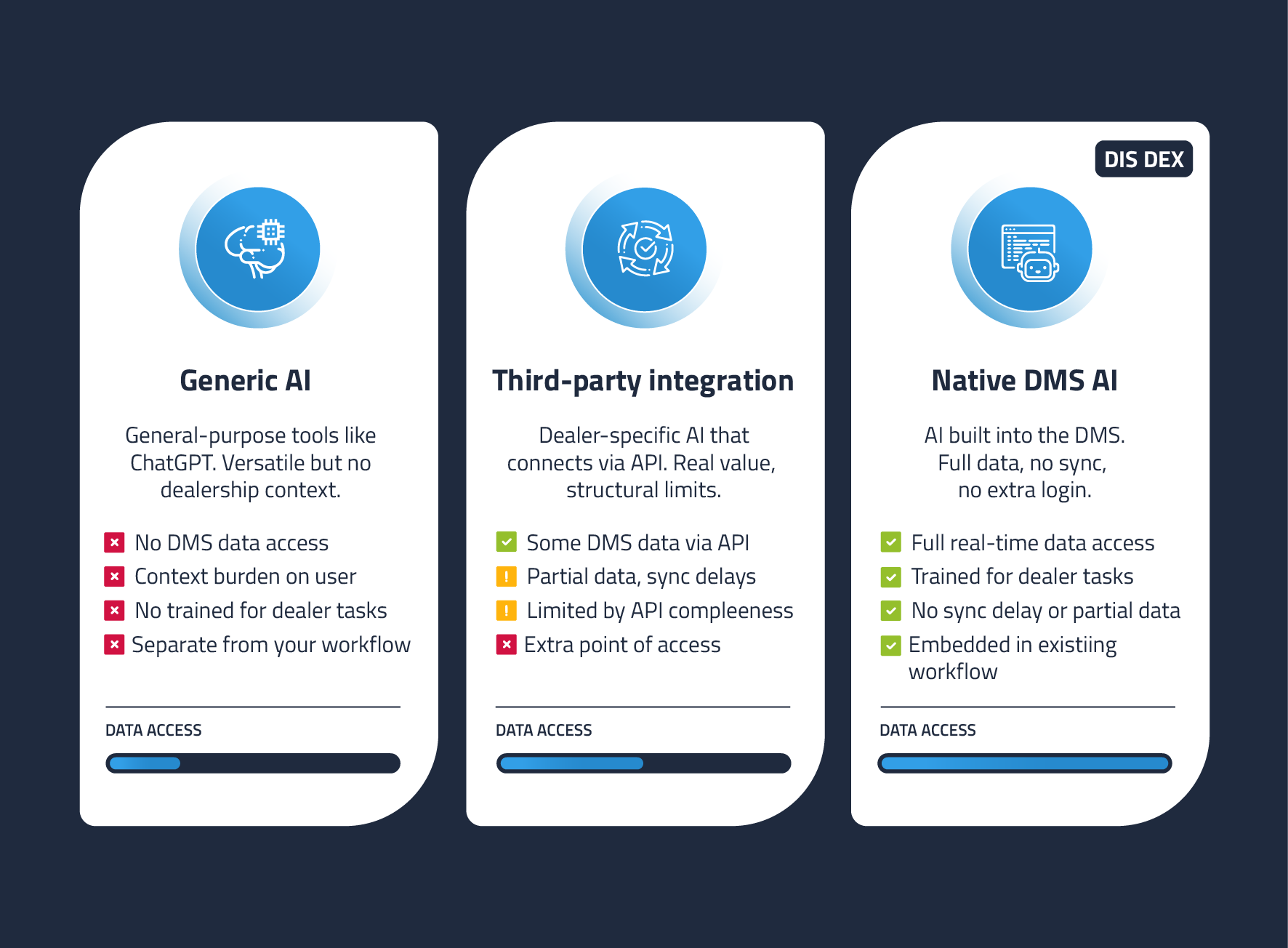
Native DMS AI
There’s the approach we’ve taken with Dex, an AI that’s native to the DMS itself. It lives inside the DIS ecosystem, which means it has direct access to everything: your work orders, your parts inventory, your customer records, your accounting data.
The Bottom Line
AI can save your team time on repetitive tasks. It can surface insights from your data that you’d never find manually. It can help you respond to customers faster and more personally. But it can’t replace the relationships your team has built. It can’t replace a technician’s hard-won expertise. And it can’t make the strategic decisions that define your business.
The smartest approach? Let AI handle what it’s good at so your people can focus on what they’re good at. But make sure you’re choosing the right AI to begin with, one that adheres to the specifics of equipment dealership operations, is trained for the tasks your team actually performs, and is native to the DMS where your business runs. That’s not a threat to the way you do business. That’s a better version of it.