

If your dealership isn’t already focused on reaching fixed absorption, it’s time to start. It’s a key strategy for building a resilient business capable of weathering economic downturns. Although fixed absorption has been a standard in the auto industry for years, the equipment sector still has opportunities to catch up. As profit margins continue to shrink, providing outstanding service is essential for dealerships to remain competitive.
What Is Fixed Absorption and Why Does It Matter to Dealerships?
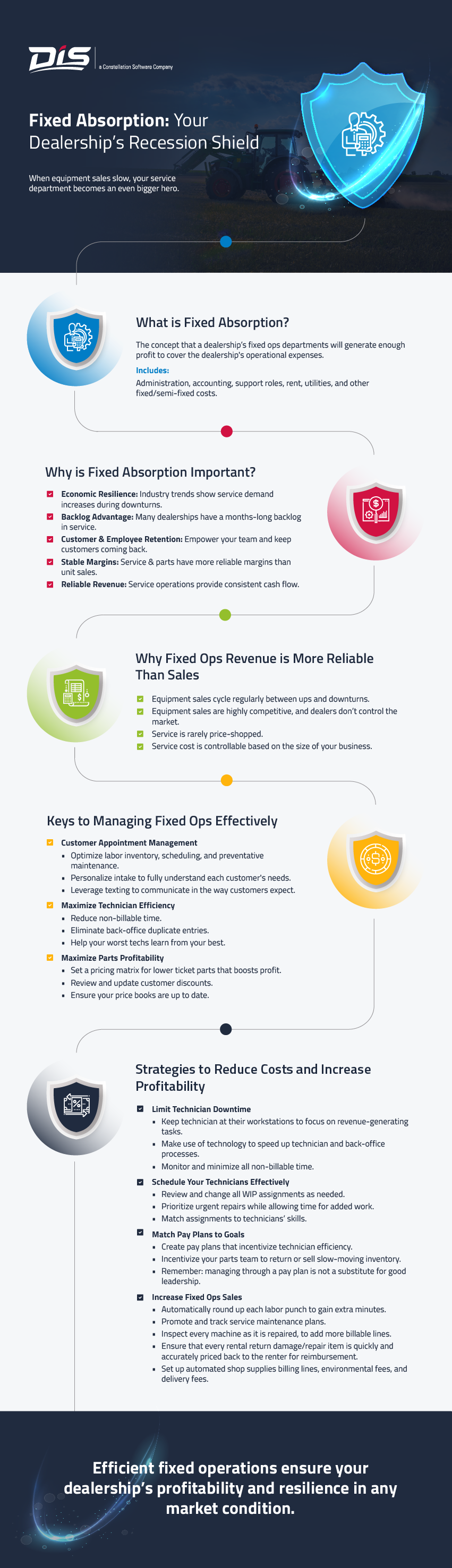
Fixed absorption is the ability of your dealership’s fixed operations (service, parts, and related departments) to generate enough gross profit to cover your dealership’s operating expenses.
These expenses typically include:
-
Administration and accounting
-
Support roles
-
Rent and facilities
-
Utilities
-
Other fixed or semi-fixed costs
When fixed absorption is strong, your dealership can remain profitable even when unit sales decline.
Why Is Fixed Absorption Critical During Economic Downturns?
Fixed absorption becomes most valuable when the economy tightens. Industry trends consistently show that service demand increases during downturns, even as equipment purchases slow.
Key benefits include:
-
Economic resilience: Customers repair instead of replace.
-
Backlog advantage: Many dealerships already have months of service work scheduled.
-
Customer and employee retention: A steady workflow keeps technicians engaged and customers loyal.
-
Stable margins: Service and parts margins are more predictable than unit sales.
-
Reliable cash flow: Fixed ops deliver consistent revenue regardless of sales cycles.
Why Is Fixed Ops Revenue More Reliable Than Equipment Sales?
Equipment sales naturally move in cycles: ups, downs, and pauses driven by market forces outside your control.
Fixed operations, however, behave differently:
-
Equipment sales are highly competitive and price-driven.
-
Dealers don’t control market pricing for units.
-
Service is rarely price-shopped.
-
Service costs scale based on your business size.
-
Labor and parts margins remain steadier over time.
In short, fixed ops revenue is controllable, while equipment sales are not.
How Can You Manage Fixed Operations More Effectively?
Strong fixed absorption doesn’t happen by accident. It requires intentional management across service, parts, and staffing.
How Can Better Customer Appointment Management Improve Fixed Absorption?
-
Optimize labor inventory, scheduling, and preventative maintenance.
-
Personalize the intake process to fully understand customer needs.
-
Use texting and digital communication to meet modern customer expectations.
How Can You Maximize Technician Efficiency?
-
Reduce non-billable time wherever possible.
-
Eliminate duplicate data entry between the shop and back office.
-
Enable knowledge sharing so underperforming technicians learn from top performers.
How Can You Improve Parts Profitability Without Increasing Volume?
-
Implement a pricing matrix for lower-ticket parts to boost margins.
-
Regularly review and adjust customer discount structures.
-
Keep price books accurate and up to date.
What Strategies Reduce Fixed Ops Costs While Increasing Profitability?
How Can You Minimize Technician Downtime?
-
Keep technicians in their bays focused on billable work.
-
Use technology to speed up shop and administrative processes.
-
Track and reduce all forms of non-billable time.
How Can You Maximize Technician Efficiency?
-
Reduce non-billable time wherever possible.
-
Eliminate duplicate data entry between the shop and back office.
-
Enable knowledge sharing so underperforming technicians learn from top performers.
How Can You Improve Parts Profitability Without Increasing Volume?
-
Implement a pricing matrix for lower-ticket parts to boost margins.
-
Regularly review and adjust customer discount structures.
-
Keep price books accurate and up to date.
What Strategies Reduce Fixed Ops Costs While Increasing Profitability?
How Can You Minimize Technician Downtime?
-
Keep technicians in their bays focused on billable work.
-
Use technology to speed up shop and administrative processes.
-
Track and reduce all forms of non-billable time.
How Should You Schedule Technicians for Maximum Output?
-
Continuously review and update work-in-process assignments.
-
Prioritize urgent repairs while leaving room for add-on work.
-
Match jobs to technician skill sets, not just availability.
How Can Pay Plans Support Fixed Ops Performance?
-
Design pay plans that reward technician efficiency.
-
Incentivize parts teams to sell or return slow-moving inventory.
-
Remember: pay plans support leadership…they don’t replace it.
How Can You Increase Fixed Ops Sales Without Adding Headcount?
-
Automatically round up labor punches to capture lost minutes.
-
Promote and track preventative maintenance plans.
-
Inspect every machine during repairs to identify additional billable work.
-
Quickly and accurately bill rental return damage back to renters.
-
Add automated billing lines for shop supplies, environmental fees, and delivery charges.
Is Fixed Absorption the Key to Long-Term Dealership Stability?
Yes. Efficient fixed operations are the backbone of a profitable, resilient dealership. When sales fluctuate—and they always do—fixed absorption keeps your business stable, your team confident, and your customers coming back.
Strong fixed ops don’t just protect your dealership in a recession—they position you to grow when the market rebounds.